Showing posts with label Sri Lanka. Show all posts

Tuesday, 24 February 2015

My Taste of Sri Lanka

When in Sri Lanka, I forgo my usual continental breakfasts in favour of the local. So I mostly eat dosa (thosai), hoppers or appa and string hoppers with the various curries (fish, parippu/dhal, polos/young jackfruit, potato, squid, shrimp, etc.), and sambols (Gotukola/Pennywort, Pol/spicy coconut, Lunu miris/onion, etc.). Then usually there are the various breads like Paratha, Pittu (flour & coconut funnel cakes), and Pol roti (like our lempeng kelapa). I also like the other Sri Lankan traditional food of kiribath (milk rice) which you eat with sambols, although I prefer the sweet, especially the one with the mung beans.

I really like the breakfast at Mount Lavinia Hotel (MLH) because they make the iconic appa fresh on request. It is rather odd (read: different) though, that you can have an egg sunny side-up in the middle of the appa. I still do prefer our Malaysian version of a sweet centre.

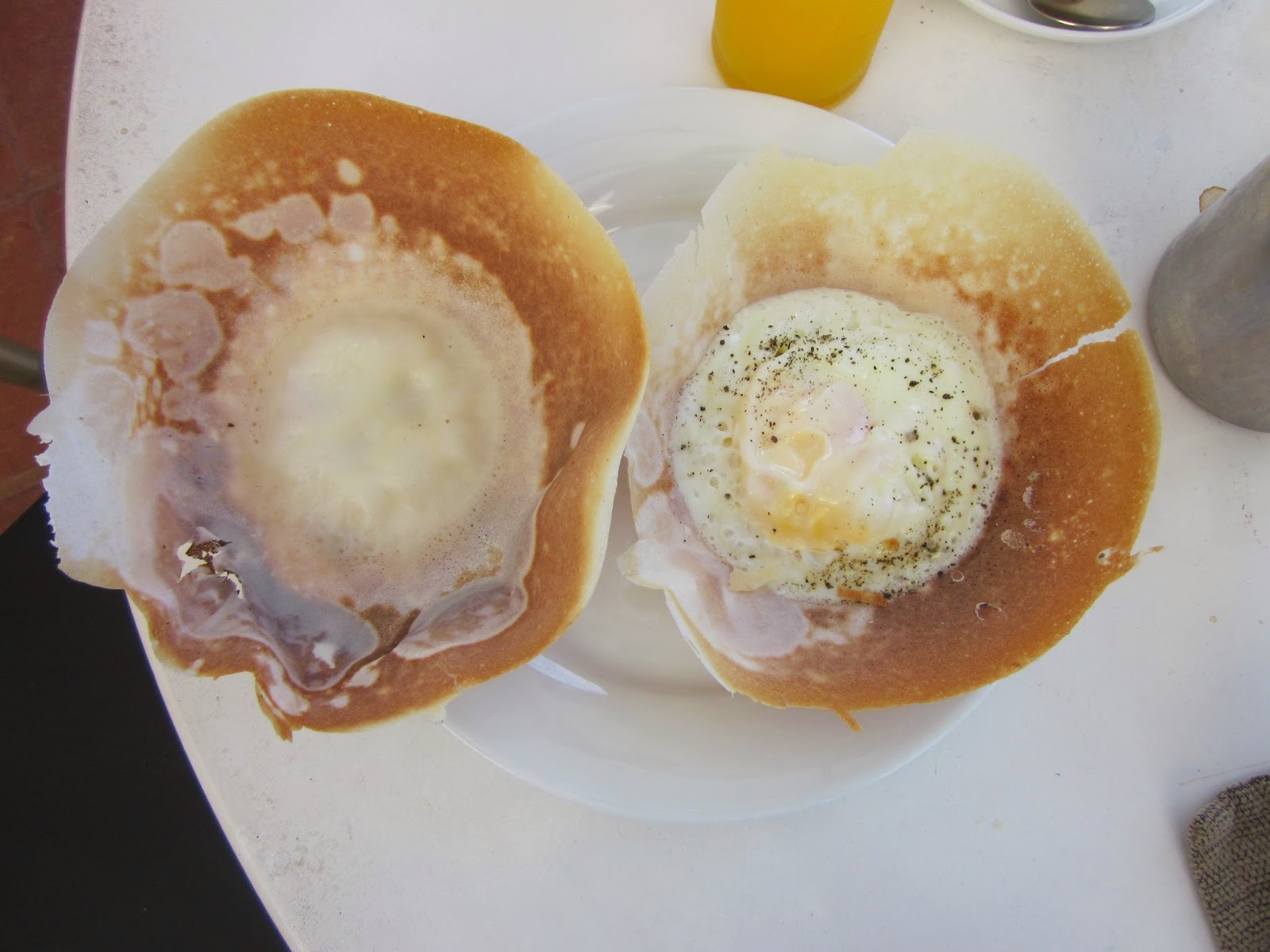
As at MLH, our breakfasts at the Berjaya (Malaysian) Hotel were also mostly local Sri Lankan dishes.


Then there are many kinds of fruits in Sri Lanka, and so many are similar to ours, both our countries being in the tropics; banana, papaya, mango, rambutan, avocado, durian, pomegranate, carambola, water melon, mangosteen, lime, pomelo, dragon fruit, jack fruit, etc. There are passion fruits of both the yellow or purple variety, and really sweet ananas or pineapple. There are the Kilo Pera or Kilo Gram Guava (known to weigh 1 kilogram mostly) savoured with chilli powder and salt.


A rather unique tasting fruit juice I discovered is that of the Wood apple (mostly growing wild), with its slight taste of sweet and sour but quite nice. Some describe its taste as that of blue cheese with tamarind. I like to eat blue cheese so I guess I am okay with wood apple. (I have just found out that we do have wood apple in Malaysia - gelinggai/belinggai - but I have never seen or tasted one before this!)


Our favourite drink in Sri Lanka is of course the Thambili or King coconut (water), which we try to get at every opportunity. The heat makes thambili the drink of choice. It is good that you can find this orange coloured coconut in many places on the streets. And it only costs 50 rupees!

One evening we dined at the Rasa Malaysia restaurant by the ocean. Okay, the Chef was Malaysian, especially flown out from Pulau Tioman, so the food was not quite Sri Lankan, yet not quite rasa Malaysia. Anyway A was feeling under the weather and wanted to 'cool down'. But there was no thambili on the menu. Then we spied a tree in front of the restaurant that had coconuts on it. We asked and they obliged! Thank you for the sweetest thambili ever. Or is it sweetest because it was gratis?

                            Thambili @ Rasa Malaysia                            Thambili @ Pinnawala

Mostly the thambili is consumed au naturel but sometimes I go for sweet, so jaggery (like our gula melaka) is added.

                                          Kurumba hora - Thambili with jaggery @ The Shore by O!

On our road trip to Kandy we passed by Cadjugama/Kajugama, where kaju or cashews grow in abundance. You can buy these nuts from roadside vendors (usually ladies in colourful attire) or some little shops. Eat them roasted and also spiced with chili. We bought enough to munch our way throughout our stay in the island.

                                          Cashew nuts of Kajugama

Sri Lanka is a spice island especially famous for cinnamon. There are many spice gardens to visit throughout the country, and again the herbs and spice plants are rather similar to what we have in Malaysia. But they do grow the second most expensive spice in the world (vanilla) rather more successfully than us.

When we visited the Island Grove Spice Garden, it was lunch time. I had fried rice which is not really Sri Lankan food, but is now ubiquitous in most eateries. My prawn fried rice was served with the local condiment of mango chutney.

                            Island Grove Vanilla                                       The Village Restaurant fried rice

With so much tea fame, of course Sri Lankans do drink a lot of tea. Our driver/guide stops for our bio-breaks at eateries or places that also serve tea. Quite Anglophile really... Visits to tea plantations and factories are a must for tourists, including us (although a train ride in tea country still eludes me). 

                                          White tea at Glenloch Tea Factory

                                          Tea and cakes at Barefoot

Then of course you have to have your last cup of Ceylon tea at the airport where there are many tea pavilions/cafes to choose from. Bon appe...tea!


10-15 February 2015

Sunday, 22 February 2015

Colombo and Sunsets on a Suburban Beach


We went sight-seeing in Colombo the rather lazy way. No adventurous walking, no nervous rides in the ubiquitous three-wheelers, no crowded public buses either. So most of the city and its various landmarks were viewed through rather dusty car windows.


But I made a special request to get out in the ever busy and chaotic Pettah to get close-up pictures of the Jami Ul Alfar Mosque with its interesting candy-striped red and white brickwork. There was renovation going on and parking nearby was practically impossible! But our kind driver/guide stopped and waited for me right in front of the mosque, to enable me to quickly go in and take a few pictures. For a while, we literally and practically stopped the crazy traffic in Pettah!


Colombo is a mix of old and new. Old colonial buildings, new modern skyscrapers. Also historic and contemporary religious buildings of temples, dagoba (Buddhist stupa), mosques and churches.


Another stop was the Gangaramaya Temple. (We missed their Navam Perahera {procession of some 50 or more elaborately decorated elephants, cultural & folk dancers, jugglers, stilt-walkers, fire twirlers, and drummers, etc.} on the February poya {full moon} day, which fell on the 14th & 15th or was it on the 2nd & 3rd? Never mind, we missed it alright.)


A... waiting for a bus at the Gangaramaya bus stop. As if!

In our continuing rendezvous around the city of Colombo, we spot more of its important landmarks - the City Hall, the Lotus Pond Theatre, etc., etc.


We also stopped a while at the Independence Memorial for our obligatory photo shot.


On this trip we spent more time on the beach at the southern Colombo suburb of Mount Lavinia. Because Sri Lanka is an island in the Indian Ocean, so we thought we'd get our feet really wet with the waters of this vast mysterious ocean. And... the beautiful sunsets completed the experience.


10-15 February 2015

Saturday, 21 February 2015

Kandy in (and out of) the Rain

After a long road trip from Colombo, we reached Kandy, and immediately the overcast sky opened and poured down the rains. But this city still fascinates. As the Lonely Planet put it, "Some days Kandy's skies seem perpetually bruised, with stubborn mist clinging to the hills surrounding the city's beautiful centrepiece lake. Delicate hill country breezes impel the mist to gently part, revealing colourful houses and hotels amid Kandy's improbable forested halo... Here's a city that looks good even when its raining."


This second city of Sri Lanka is 115 km from Colombo and is at an altitude of 500m. Kandy was 'the capital of the last Sinhalese kingdom, which fell to the British in 1815 after defying the Portuguese and Dutch for three centuries'. The focus of present-day Kandy is its lake (created in 1807), with the city centre being immediately north and west of it. The city also spreads into the surrounding hills.

Just north of the Kandy Lake is Sri Dalada Maligawa or the Temple of the Tooth Relic, which houses Sri Lanka's most important Buddhist relic - a tooth of the Buddha. This was said to have been snatched from Buddha's pyre and later smuggled into Sri Lanka in a Princess's hair. Kandy city is a Unesco World Heritage site, in part due to this temple.


There are many religious and architectural details of note around this temple site. Our freelance guide pointed these out, while outside it just continued raining.


Apart from beautiful doorways, both ceilings and floors too have interesting architectural details e.g. the moonstone or carved doorstep at the temple entrance (no, its not made of the semi precious moonstone).


The Temple of the Tooth Relic is a most visited heritage building, both by worshipers and tourists. It was constructed under Kandyan kings from 1687 to 1707, and from 1747 to 1782 the temple complex was part of the Kandyan royal palace. The famous Kandy Esala Perahera (procession) which takes place annually in July/August, is held to honour the sacred tooth enshrined in this historic temple.


Before leaving Kandy, we took in the view of Kandy Lake and its surrounds from the scenic lookout point of Arthur's Seat. The sky was still grey and overcast when we made our way back to Colombo.


Ref: Atkinson, B. et al. Sri Lanka (Lonely Planet).11th ed., 2009. Ex Libris CNB 

Friday, 20 February 2015

The Glenloch Tea Factory & Museum

The Glenloch Tea Factory & Museum is sited in Katikitula in the district of Nuwara Eliya. We visited it on our road trip to Kandy from Colombo.

At the factory, we were greeted by Vishaka and she graciously guided us through the several processes fresh tea leaves (picked from the bushes of Camellia sinensis) go through before they are graded and finally packed for us to enjoy our cups of tea.

Did you know that tea, whether black, green, yellow, blue (oolong) or white, all come from the same tea plant? 75% of tea production end up as the popular black tea. English Breakfast Tea is my favourite black tea, with a dash of milk and honey. Slurp! Oops, I mean... sip!

In the factory we saw how the plucked tea leaves are first withered/wilted. This is for the purpose of removing excess water from the leaves. This process promotes the breakdown of leaf proteins into free amino acids and increases the availability of freed caffeine, both of which change the taste of tea.


Then the leaves are rolled, i.e. chopped into tiny pieces or macerated by the machines shown below. This is to promote oxidation. Some of the leaf juices are released that aid in oxidation which (again) change the taste of tea.


The leaves are then left to ferment/oxidise. Oxidation turns the green leaves to a copper colour. Under or over-oxidation produces the type of tea desired. Black teas are 100% oxidised.


After drying with hot air the tea leaves change colour to brown or black, then undergo the final process of sorting by size and grade.


At the end our tour we got to enjoy little cups of white tea. I'm no tea connoisseur so for me its the first I've seen, let alone drink white tea. I had only been familiar with green tea or black tea.


We then visited the Tea Museum in an annex building. There are exhibits on the history of tea in Sri Lanka and machinery previously used in the processing of tea. The pioneers of Ceylon tea, James Taylor and especially Sir Thomas Johnstone Lipton made this Indian Ocean island well known to the world at the end of the 19th century. Lipton was also a marketing genius who has made his name synonymous with black tea the world over.


Anyway this particular visit reminds me to revisit our own tea plantations and factories in Cameron Highlands. Because there is so much more to tea than just enjoying a cuppa!

Ref: Victor H. Mair &  Erling Hoh. The True History of Tea. Thames & Hudson, 2009. Ex Libris CNB 2086
12 February 2015