Friday, 8 November 2013

The Historic Heart of Melaka

Melaka's rich historic past has always been a fascinating story. No matter how many times we visit Melaka, we never fail to feel the historic ambience all around. I think we all know how the Malacca Sultanate (1400-1511) started with Parameswara (Sultan Iskandar Shah) founding it at the spot where a white mouse deer, on being cornered by his hunting dogs turned around and 'barked' at the dogs, chasing them away. The old Sultanate Palace/Istana of the Sultan, thought to be on a hill (St Paul's) now has a replica built to reflect Melaka's glorious past, at the foot of the same hill.
(Pic Istana)

Detail  on Porta de Santiago (CNB 2013)

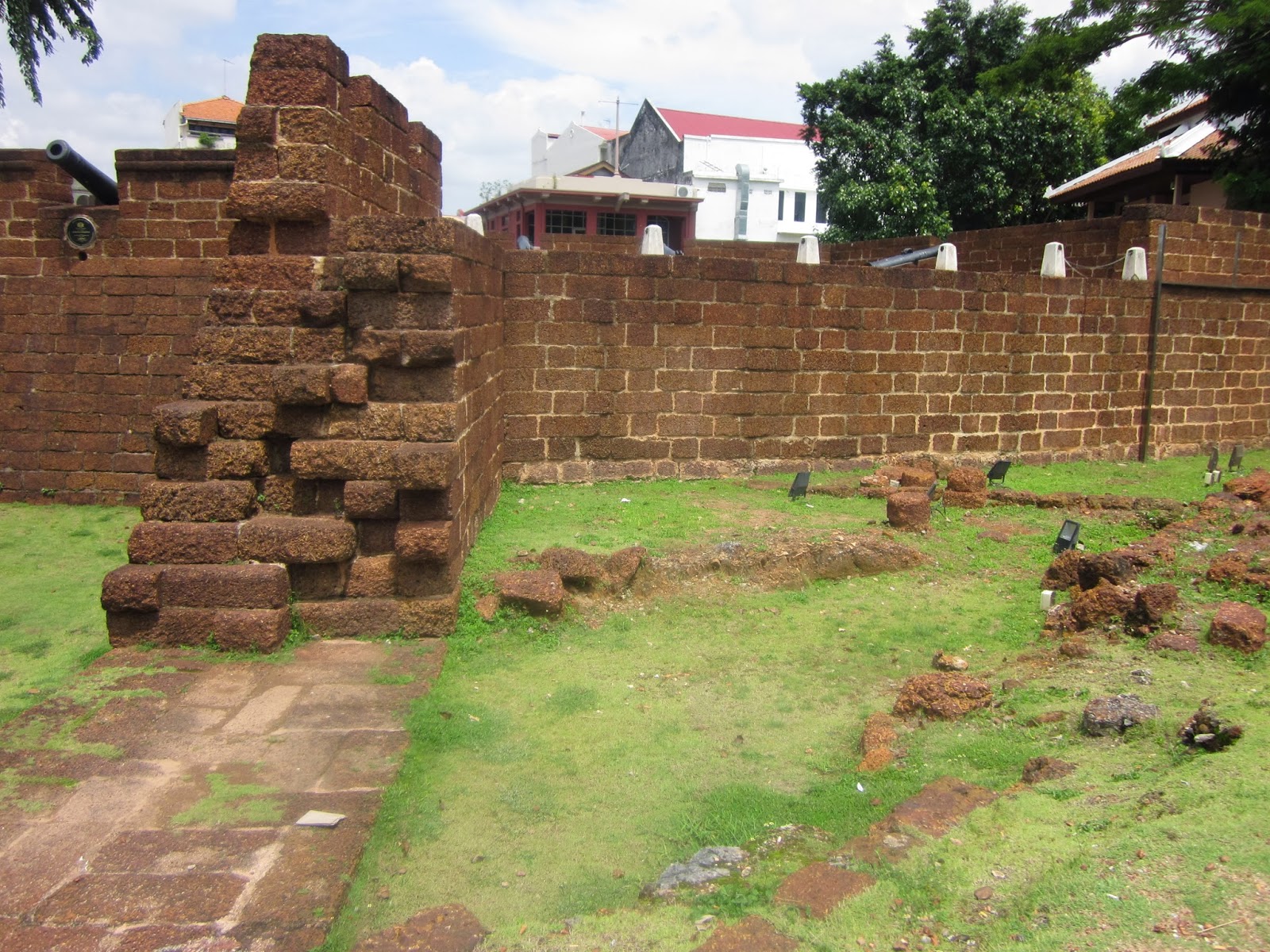
The Portuguese led by Alfonso de Albuquerque came in 1511 and the Melaka Sultanate fell. Sultan Mahmud Shah went on to found the Johor Sultanate from Kota Tinggi. The fort A 'Famosa built by the Portuguese and taken over by the Dutch who invaded Melaka in 1641, was destroyed by the English in 1806 except for the Porta de Santiago (gate), saved by Stamford Raffles, who was visiting at the time. It is among the the oldest surviving European architectural remains in Asia.

At the iconic Porta de Santiago (BB 2013)

A recent discovery while excavating at the site to build the modern Taming Sari Tower is of the Middelsburgh Bastion, a structure part of the fort built to safeguard the Malacca River. This is probably the second most important watch tower after the Santiago Bastion.


The clock tower fronting the Stadthuys (CNB)
The Dutch occupation of Malacca (1641 - 1825) was the longest period the state was under foreign control. During this time, the importance of Malacca declined due to the Dutch preference of Batavia (Jakarta). In the 17th century Malacca ceased to be an important port and the Johor Sultanate became the dominant local power due to its alliance with the Dutch.

During the 183 years of their rule, the Dutch left behind many structures, the most outstanding being those in the Dutch Square - the salmon red/pink buildings of the Stadthuys, the clock tower, the Christ Church (1753), etc. The Stadthuys, housing the town hall and governor's residence then, was built between 1641 and 1660. This Dutch colonial structure now houses five museums. Unfortunately at this time, renovations are taking place, so the building is closed. Still, the other buildings in the complex make for great snapshots.

Interestingly, there seem to be many Dutch graves, especially in the ruins of St Paul's Church on the hill of the same name. On reading their epitaphs on the grave stones, they mostly died young (relatively).

The St Paul's Church ruins (CNB 2013)

Dutch grave stone detail (CNB 2013)

2-5 November 2013

Thursday, 7 November 2013

Peranakan Nostalgia at Jalan Tun Tan Cheng Lock

While in Melaka, one can't help but be very aware of Peranakan (Straits born Chinese) culture, especially when in its Chinatown area. The very narrow Jalan Tun Tan Cheng Lock, (formerly known as Heeren Street from the Dutch colonial period), was the millionaire's row for Melaka's Chinese merchants during colonial times.

Walking from our hotel, a mere stone's throw away is Heeren House, at the corner of Lorong Hang Jebat and the entrance to Jalan TTCL.  This guest house by the Melaka River used to be a warehouse, a coffee shop and a family home.

Heeren House by the Melaka River (CNB 2013)

Architectural detail of a phoenix and peonies adorning a
building (CNB 2013)

Along the street there are many art and craft shops and galleries in what used to be traditional shophouses. Some of the shop fronts now exhibit pretty container gardens and are beautifully decorated, both outside and inside. We also noted that there are buildings undergoing conservation/restoration. We stopped by a newly opened shop exhibiting colourful embroidered Nyonya kebaya, and before you know it, B had bought herself a kebaya & sarung set. Very appropriate souvenir of Melaka!

The container garden of the Artist Gallery (CNB 2013)

Pretty kebayas in a shop (CNB 2012)

A bright blue shop, 'Colour Beads', attracted our attention from afar and inside we discovered a treasure trove of  beaded shoes, a skilled artisan making them at the back of the shop. The shoes are hand made from A to Z, the minuscule beads hand sewn to make pretty floral patterns (for the old style shoes) and geometric ones (for the new style shoes). At around RM300, you can wear art on your feet! Who needs Louboutins, eh?

B in front of the bright blue Colour Beads shop (CNB 2013)

BNHC window detail
The next day we returned to Jalan TTCL for a 45 minute guided tour at the Baba Nyonya Heritage Centre, which proved most interesting for the hybrid culture of the Baba Nyonya or Peranakan (assimilated/Straits born Chinese). Shirley our guide, explained how a millionaire Peranakan household operated in their hey day during colonial times. The Peranakans are descendants of the first Chinese men who came to Malaya and married local women. In fact the place of honour at the ancestral worship alter of this particular house is of a Bugis Malay woman.

The furnishing in the house is rich and elegant. The wood furniture have mother-of-pearl inlay, there are intricate carvings on lacquer screens, delicately embroidered wall hangings and chandeliers and mirrors from Europe.

No photography is allowed in the house and Shirley our guide is a no-nonsense person whom we would not cross swords with. At the end of the tour we gave her an 'excellent' review for a job well done, and then persuaded her to pose for pictures - outside the house, of course.

B and Shirley (CNB 2013)
2-5 November 2013

Wednesday, 6 November 2013

A Melaka Getaway

Melaka's salmon pink/red buildings (CNB 2013)

The recent public holidays of Deepavali (02/11/13) and Maal Hijrah (05/11/13) afforded some getaway time, so B and I made a road trip down to the historic city of Melaka, just a two-hour drive away from KL/Shah Alam. For nearly four days there, it was sheer indulgence in history and culture (read: food, art, architecture, and more ... food).

Getting off the North-South highway at Ayer Keroh was the start of a long and slow drive into Melaka City. Our first stop was at the Bayview Hotel in Jalan Bendahara, where we had a room on the unlucky 13th floor! This 25 year old hotel needs refurbishing and they seem to be getting on with it, starting with their air conditioning system. I think they should look at their lifts as well, because we had a minor scare in one. But I will spare you the details.

Anyway that did not stop us from stuffing ourselves with seafood during dinner at a restaurant nearby. It was Sri Lankan crabs and pomfret fish followed by street-side durian for dessert!

B and street-side durian dessert - delish! (CNB 2013)

The next morning we walked next door to the oldest functioning Catholic Church (built in 1710), the St Peter's, for a look-see. It being Sunday, there was a service being held then. So we left after a few snapshots of the church's facade. After checking out, we joined the traffic jam into the happening historic heart of Melaka city centre. For two nights we will 'zonk out' at the Hangout@Jonker (hotel) on Lorong Hang Jebat.

St Peter's Church (CNB 2013)

The iconic clogs of Jonker Street (CNB 2013)

From here, in muted sunshine and afternoon rains, we did all our 'absorption' of the history and culture of Melaka around us - its past, architecture, art and crafts, foods, people and current attractions. We covered the main streets of Jalan Hang Jebat (aka Jonker Street), Jalan Tokong and Jalan Tun Tan Cheng Lock. Of course we did the Melaka River cruise and rode on the 'eyesore' Taming Sari Tower for great all round views of this Unesco World Heritage site (since 07/07/08). Revisiting the iconic A'Famosa (appropriately 'The Famous' in Portuguese), Stadthuys and St Paul's Hill seems a must-do whenever in Melaka. (I will write more detailed postings later).

The Porta de Santiago of the A'Famosa fortress (CNB 2013)

After we checked out from Hangout, we had to really hang out at the Mediterranean-inspired 'home by the river', the Casa Del Rio, because it was pouring again. The heavy rains and the relative cold make for ravenous appetites, so despite having had lunch earlier, what better fare than 'sinful' gourmet pizzas named according to the 'seven sins'. Of course we chose 'Gluttony' (what else?) washed down with mocktails of Ginger Tom and Funky Monkey. Then the rains subsided, and we left for home, sweet home.

Hangout@Jonker breakfast; when in Melaka,
wear kebaya, eat roti kaya.  (BB 2013)

Gluttony at the River Cafe, Casa del Rio Melaka (CNB 2013)
2-5 November 2013

Friday, 1 November 2013

Pengembara

Aku adalah pengembara
     yang tak berpeta
langkah-langkahku kerap serakah
sehingga aku tak terhitung
musim-musim hijrah
merakam setiap sumbangnya langkahku
yang kian lesu.

Aku adalah pengembara
    yang alpa
rakus dan angkuh
seakan-akan melupakan
ikrar yang pernah ku baitkan
   pada-Mu.

Oh! Betapakah hinanya langkah-langkah ini...

P. H. MUHAMMAD ABD. AZIZ
Awal Hijrah 1407

Dari Suara Di Ambang Senja: Antologi Puisi [P. H. Muhammad Abd. Aziz]
Bandar Seri Begawan, Dewan Bahasa dan Pustaka, 1992.
Ex Libris CNB 1354

Thursday, 31 October 2013

Legoland Malaysia in Nusajaya, Iskandar

The iconic 'trade me' man (CNB 2013)

Legoland Malaysia Resort (opened 15 Sept. 2012) promises family fun where "almost everything is hands-on, so you can push, pedal and program, or steer, squirt and splash your way through a truly interactive experience - and of course there's building too". When we were there recently, we were a family of: 'wargamas' mother with two grown-up daughters, a nephew and his wife. No young children in tow!

There are 40 rides, shows and attractions, and it would take nearly two days to do them all perhaps. But we were there for only half a day, so we were most selective, aided by the late afternoon heavy downpour.

The fierce cute dragon scaring away children (CNB 2013)

Soft cuddly froggies to be won at a games booth (CNB 2013)

Miniland is touted as the centrepiece of Legoland Malaysia where Asian landmarks (on a scale of 1:20) have been recreated using more than 30 million LEGO bricks. That's a whole lotta (sic) plastic bricks! We can't help but be impressed with these beautiful miniature buildings. Especially the Twin Towers and the Taj Mahal. But our harsh tropical weather will take a heavy toll on them, so maintenance will be quite a headache?

Kuala Lumpur Railway Station in Miniland (CNB 2013)

B strides out with a LEGO father & daughter
(CNB 2013)

Legoland Water Park had its 'soft launch' the day we were there. I am not a fan of water theme parks in general, but rafting on the 'lazy river' looked inviting enough. For next time, maybe. Maybe ...

Part of the Water Park (CNB 2013)

Rafting along the lazy river (CNB 2013)
Ref: www.legoland.com.my

Saturday, 26 October 2013

The Mausoleums of Kota Tinggi

In Kampung Makam (the original site of old Kota Tinggi) stands a beautiful mausoleum building (and an equally beautiful mosque next to it) housing the graves of the (in)famous 'Sultan Mahmud mangkat dijulang'* and other royals descended from the Melaka Sultanate ... err ... plus the Sultan's favourite pet kucing bertanduk (horned cat).

With the fall of Melaka to the Portuguese in 1511, Sultan Mahmud Shah fled the sultanate and established the first court of Johor in Pulau Bentan in the Riau archipelago. But with the Portuguese attack there in 1526 he fled to Sumatra and died two years later. His son Alauddin Riayat Shah found a new court on the upper reaches of the Johor River, fending off assaults by Portugal and the Sumatran sultanate of Aceh. The Johor court aligned itself with the Dutch who arrived at the end of the 16th century and was instrumental in the successful siege of Melaka by the Dutch in 1641. Johor became the supreme Malay kingdom during the 17th century but by the 1690s under the despotic rule of Sultan Mahmud Shah II, it declined, marking the end of the Melaka dynasty.

*Sultan Mahmud Shah II (1685 - 1699) was assassinated by his own Admiral, Megat Seri Rama (Laksamana Bentan) while being carried on the royal litter for Friday prayers.

Mausoleum of Sultan Mahmud mangkat dijulang (CNB 2013) 

The grave of Sultan Mahmud Shah II in the foreground 

The Fort and Admiral grave (sic)
Laksamana Bentan killed the Sultan to avenge the death of his wife Dang Anum. The Admiral was away fighting off pirates on the shores of southern Johor when Dang Anum was put to death for eating a piece of jack fruit from the Sultan's garden.

The graves of Laksamana Bentan and Dang Anum are located in Kampung Kelantan, by the bank of the Sungai Johor in Kota Tinggi. According to the marble information plaque, a fort may well have been in place here too.

The grave of Laksamana Bentan (CNB 2013)

The mausoleum of Laksamana Bentan & wife (CNB 2013)

Other than these two mausoleums that we visited this time, I had visited one other previously in 2006, that has a fascinating tale about the deceased. But we did not have the time visit the grave of the beautiful Cik Siti (erroneously aka Cik Siti 99, even Cik Siti Jalang!), whose 99 husbands were said to die on their wedding nights. Save the lucky 100th!

Another mausoleum that we missed too is that of Tun Habab (Chief Minister of Johor during the reigns of Sultan Ibrahim Shah and Sultan Mahmud Shah II; installed Sultan of Johor on the demise of the latter who had no heir). So much history, so little time ...

Thursday, 24 October 2013

Continuing Our Johor Weekend Rendezvous

Early Sunday morning, we got up to a nice breakfast of bihun and tea at Iman's, after which we made quite a thorough inspection of the five-room bungalow and its grounds. We met Sukma the daily help, and teased the two playful pet kittens. A & B also enjoyed reminiscing with their favourite cousin (Iman, of course); about their childhood days and growing up years in the kampung in Teluk Kumbar, Pulau Pinang in the 80s and 90s.

Iman & Pigeon orchids in the grounds of his home (CNB 2013)

Iman played gracious host and planned a full day for us. First he drove us past (and through) acres of oil palm plantations to a beautiful and rather secluded beach in the Tanjung Sedili area to preview it only, because none of us were prepared for a dip in the sea then. Another time, maybe. We also had glimpses of the Sedili wetlands, the rocks along the so-called dinosaur trail and the site of the demolished controversial surau in Tanjung Sutera resort.

On the beach (NJ 2013)

At Sedili Besar we stood by Kuala Sedili (remember the classic eponymous song?) where the river flows into the South China Sea. We took pictures of the rather neglected facades of shops and dwellings and also of some friendly children playing in a park nearby (One little boy politely quipped, Buat apa tuuu...? ... to ensure we wait for him to be included in the photo-shoot!). For some mid-morning snacks, we stopped at the food stalls by the jetty in Tanjung Sedili for cempedak goreng, pisang goreng, and keropok lekor.

Boats near the jetty at Tanjung Sedili (CNB 2013)

We buy fried snacks from Ina (CNB 2013)

After Tanjung Sedili, Iman drove us towards Desaru, on a long route he'd not gone before. Along the way there were signs of the badak cipan (tapir) in areas where wildlife thrive. Seeing the acres upon acres of oil palm plantations that abound in our country, we thought of the poor displaced animals that have to make way for 'development'.

Watch out for wildlife crossing the road! (BB 2013)

For lunch, as promised, Iman took us to his favourite laksa Johor place, a small but very popular eatery by a plantation. When in Johor, one must indulge in a laksa Johor. We also had otak-otak, pepes, mee rebus and fresh coconut water. Dessert was a most delicious cendol kampung. (Do we have cendol bandar?)

Our lunch stop (CNB 2013)

After food for the body, then it was history for the soul. We went to Kampung Makam to see the Mausoleum of 'Sultan Mahmud mangkat dijulang' and other royals of the old Johor Sultanate (a revisit for me). We also (re)visited the grave of the man who killed him - his Admiral/Laksamana Bentan, in Kampung Kelantan. (More on the history/mausoleums in another posting). Back in the town, we found the Kota Tinggi Museum closed for renovations, so another time perhaps.

Kota Tinggi waterfalls from under our umbrella (CNB 2013)

We headed to Lombong for the famous Kota Tinggi waterfalls, now 'managed' by Wet World so you have to pay the entrance fee of RM7.50 pax and another RM3.00 for the car. Like yesterday, the heavy rains poured down again in the late afternoon when we arrived there, so it was indeed a very wet, wet world.

All for one ... (CNB 2013)
The waterfalls quickly became a gushing torrent and even before 6.00 pm, people were already leaving the area. We did the same, going back to a delicious dinner prepared by Sukma.

Although we were supposed to go back to Shah Alam then, we postponed it to early the next day. So on a very misty Monday morning, we said goodbye to Iman, Shila, Kota Tinggi and Johor, to head back home.