Wednesday, 24 July 2013

Landmarks of Selangor: Istana Alam Shah

The Istana Mahkota, 1903

Istana Alam Shah or Alam Shah Palace in Klang was constructed in 1960, in place of the old Istana Mahkota. Istana Mahkota, built for Sultan Suleiman for his installation in 1903, was demolished in the 1950's when work on the present Istana began on the same site. Since its construction, the Palace has undergone enlargement and significant renovation, and was the venue for the installation ceremony of the present Sultan of Selangor, Sultan Sharafuddin Idris Shah in 2003.

The Istana Alam Shah, 1960 -  (CNB 2013)

A central octagonal tower topped by a golden onion dome dominates the palace design with two wings on the side. "The high-pitched blue-tiled roofs on the new wings have been modified at the ends which are two pitched, curved gables typical of east-coast houses, in place of the old hipped roof".

The golden onion dome (CNB 2013)

The Palace is on an elevated location, overlooking the Sultan Sulaiman Mosque (see blog post 6 January 2013) and reached by a flight of stairs. 


(In progress)
Ref: Landmarks of Selangor. Jugra Publicaations. 2003.

Tuesday, 23 July 2013

Portraits of Sabahans

Sabah is fascinating, not just for being the site of world famous Mt Kinabalu and Sipadan, but for its interesting people. When M and I were in Sabah in March, we observed that Sabahans, no matter their ethnicity or tribe, are mainly most friendly and helpful. Who are the people of Sabah?

"Modern-day Sabah has been shaped by a diverse range of ethnicities, with the majority of Sabahans members of at least one of more than 30 groups. By far the biggest is the Kadazan-Dusun which comprises the Kadazan, people of the plains, and the Dusun, mountain farmers. But it also includes 40 other related tribes. The Sabah coast has long been influenced by outside groups to such an extent that the second biggest ethnic group is the Bajau, descended from nomadic seafarers and emigrants from the Philippines, just a couple of hours to the North" (Niall McIlroy for Sabah Tourism, 2011).

Here I share some photos of Sabahans who(m) we came across during our trip.
1. Pretty Eliccolina, a Dusun, works at the Jim Thompson outlet at the Nexus Karambunai Resort. She was very gracious when I went into the outlet to buy a tee.


2. Janurin works at the Lagoon Park Karambunai. He is a Bajau Darat from Tuaran and very knowledgeable about the fauna and flora in the area. He also made us aware of  the jelly fish season.


3. These girls and a boy are the very helpful front office staff at the Nexus Karambunai. I jotted down their names in my notebook, but mislaced it somewhere. When I do find it, I will name them.


4. Ever smiling Yana is one of the North Borneo Railway stewards serving on the train we took from Tanjung Aru to Papar and back. Her uniform and the thermos flasks complete the vintage train experience.


5. A fish seller at the Kinarut Tamu shows off a fish to customers. I forgot to ask his name or the name of the large fish!


6. A man selling the wakid (traditional baskets) at the back of a van at the Kinarut Tamu. He was quite happy to pose for this photo.


7. These two boys (brothers) were helping out their mother at the Kota Belud Tamu and gamely posed for this picture.


8. This beautiful old lady reminded me of my grandmother Maimunah. The way she wears her selendang as headgear is also reminiscent of how the Malay women of yore wore theirs. Now the 'tudung' is the norm.


9. This jovial lady sells tobacco and sireh at the Kota Belud Tamu. She'd offered me some sireh to try, which I found too 'sharp' for my taste. She obviously loves her sireh as her almost scarlet tongue testify. She was also one of the very few at the Tamu to sport a native headgear.


10. A young Malay woman at the Kota Kinabalu town centre dry food market. We bought some local snacks from her.


March 2013 (All pics by CNB)

Monday, 22 July 2013

Commuting from SA to KL by Train

RM5 return ticket SA-KL Sentral-SA (CNB 2013)

Sometimes when I need to go to Kuala Lumpur for something or other, I find that rather than driving there, taking the commuter train from Shah Alam is more convenient. Then I never need worry or stress about the parking problem when I get to KL. And I time it such that it is not rush hour to and fro. If I'm lucky, it is a new train and the interior is fine. If not, it is still fine because most of the time I either look out the window or people watch. I also choose to be in the pink 'Ladies only' coach, though some recalcitrant males can always be found here.

The commuter from Port Klang arrives at Shah Alam station
(CNB 2013)

The pink 'coach for ladies only' (CNB 2013)

No, no, no, no, no, no, no! None of these on-board! (CNB 2013)

The journey to KL Sentral takes about 40-45 minutes, with nine stations in between: Batu Tiga, Subang Jaya, Setia Jaya, Seri Setia, Kg Dato' Harun, Jalan Templar, Petaling, Pantai Dalam, and Angkasapuri. Sometimes I go on to Kuala Lumpur Railway Station or Mid Valley, or hop on the LRT or even the Monorail to another destination.

Busy KL Sentral (CNB 2013)

I love train travel, long or short, fast or slow. I have done the KTM North-South route but have yet to do the Gemas/West-East Coast one. It's been on my bucket list for some time now...

Sunday, 21 July 2013

Retro: A Langkawi Holiday, 1993

Touchdown at Langkawi Airport (CNB 1993)

It's yesterday once more ... 20 years ago in 1993.  It was a family holiday full of sweet memories and lots of sunburn. After a first visit in 1976 with M, this second visit 17 years later was with two daughters in tow. Flying from Pulau Pinang, it is only a half hour in the air, and the plane is descending into Pulau Langkawi already. My brother AW and his family were already there a few days earlier and they kindly came in a rented van to the airport at Padang Mat Sirat to fetch us and send us to our accommodation at DeLima Resort. Then we went out together to the Air Hangat Cultural Village to have refreshments. I do not remember any cultural activities going on then.

At Air Hangat Village with Bro AW's family (AW 1993)

The next day they had to leave Langkawi and so we took over the van for our tour around the island.

Before starting our round-island tour (CNB 1993)

We did the usual - visiting the historic sites of Mahsuri's Tomb, and the Beras Terbakar (Burnt rice) site at Kg Padang Mat Sirat; the natural wonders of  the black sand beach, and swimming in the sea at Tanjung Rhu, Burau Bay, among other activities.

M, B, A at Makam Mahsuri (CNB 1993)

Swimming in the sea at Tanjung Rhu (CNB 1993)

One night there we celebrated A's 11th birthday at the Resort restaurant. It was a surprise to discover that we were about the only customers then. Maybe the so-so food was the reason? Or we were the last customers as it was quite late? Whatever ... we did enjoy the ice cream and fruit desserts.

Happy 11th, A! (CNB 1993)
Those were lazy days in Langkawi, at the resort, swimming in the pool, mostly.

A pose while walking around the resort (CNB 1993)

The Langkawi Isles always have a special allure and I have been back a few times, also for work (read seminars/conferences). Definitely a favourite local holiday destination.

Friday, 19 July 2013

Pasar Ramadhan Shah Alam


Nasi ambeng at the Pasar Ramadhan SA (CNB 2013)

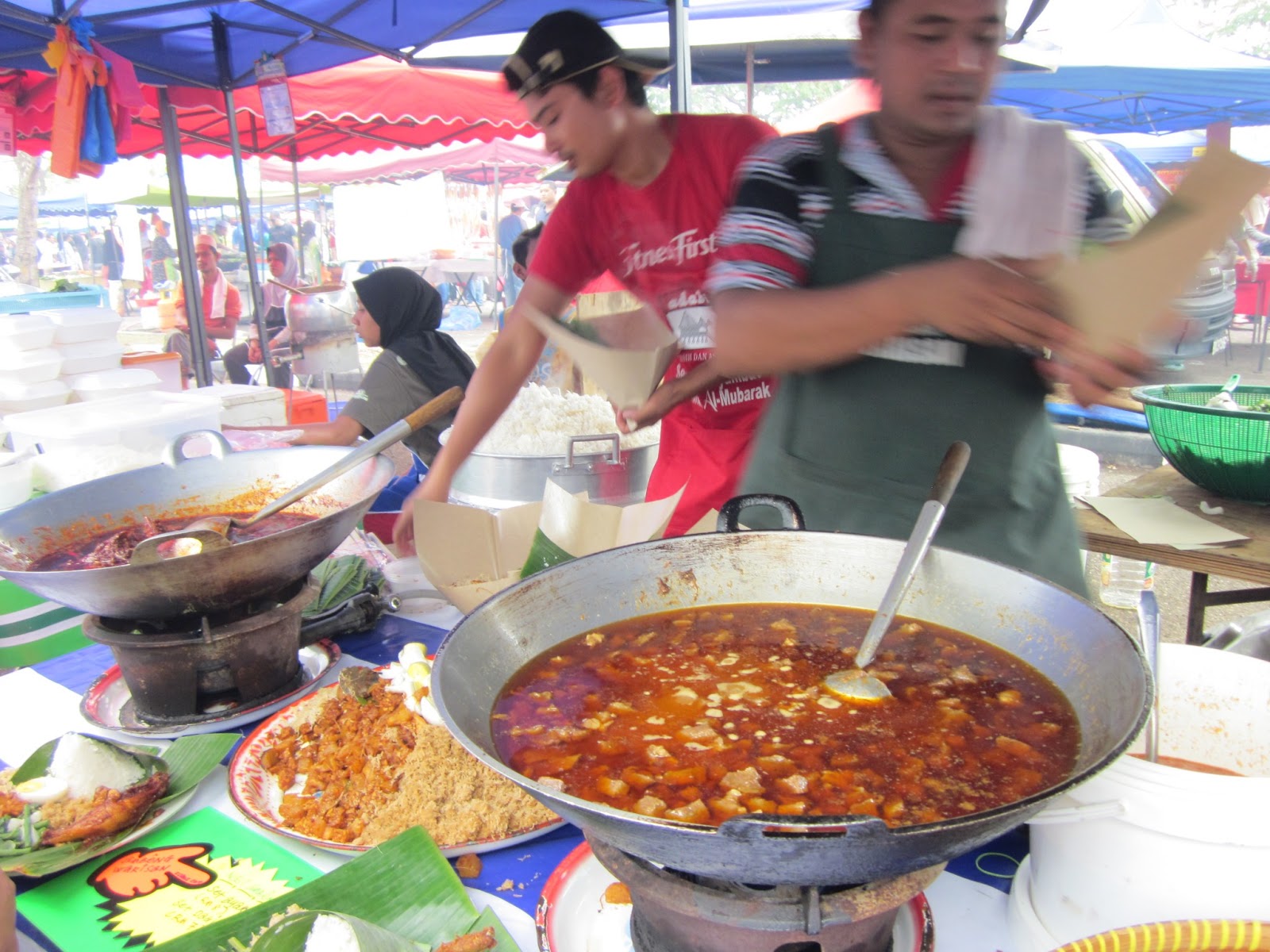
The Pasar Ramadhan in Shah Alam (Section 13) is a real feast for the eyes. Despite my resolution to not visit any Ramadhan bazaar/market this year, I still made a visit there on a recent Sunday at 4.30 pm, to err ... take photos! (Yeah, right!?). We thought we were early, but there were already so many people jostling to buy food for iftar/buka puasa and also dinner.

We observed that there were many stalls selling the various states' fare. There are several Nasi ambeng stalls - not surprising because you are in Selangor after all. Then there are the obvious Kelantan attractions of blue Nasi kerabu, golden Ayam percik, Laksam, and desserts such as Lompat tikam, Puteri mandi, Akok, etc.; Trengganu associated food - Nasi dagang, and Sata; Pulau Pinang-mari fare of Laksa Penang, Murtabak, Char kway teow; Negri Sembilan Gulai kawah, etc., etc. Of course international fare abound too - kebabs, colourful puddings, Chinese dumplings, all sorts of cakes, etc., etc. (Like Yul Bryner, the "King of Siam", I too love my 'etcetra, etcetra'.)                

Gulai kawah and Nasi ambeng in one stall (CNB 2013)

We got Nasi ambeng from this stall at RM6 (CNB 2013)

Blue Nasi Kerabu stall (CNB 2013)

Ayam golek - contributing to air pollution? (CNB 2013)

Of course when there is food, there must be drink. The drinks come in all colours and hues, of which 'blue lemon' proved outstanding. The Smurfs must be happy, but then we settled for the very safe colour of soya bean.

Blue lemon, yellow oren & brown mata kucing (CNB 2013)

B at the soya bean stall (CNB 2013)

Despite telling ourselves that we must resist buying too much, we still did. (And I thought I only went for the snapshots, ha ha!). We bought Kueh lopis, Lompat tikam, Dim sum, Nasi ambeng, Pulut udang, Sata, Ayam goreng Uncle Bob, and soya bean drink. Hello, indigestion!

Selamat berbuka puasa ... (CNB 2013)
14 July 2013

Wednesday, 17 July 2013

Two years, 342 postings

Two years ago on this date I started blogging. This is post number 343, and I have mostly enjoyed the 'journey' so far ... Sometimes I blog about what I have done, and sometimes I do what I want to blog about what I have done ... Go figure!

Monday, 15 July 2013

SA Garden Catalogue: Common Wrightia

The weather in July so far, seems to hover between days that were quite hot and balmy (and air polluted) with periods of cooler rainy intervals. This seems good for the garden (and for me since I do not really have to water it too often, ha ha!). Many more plants are in blossom since our tropical summer started.

The Common Wrightia or Water jasmine (or simply Melati in Malay) has quite a few inflorescence now in the garden. Usually a small  tree 2-5 metres tall, it has small leaves and very fragrant small dangling white flowers, produced all year round. It is a plant that is quite often used for bonsai. It is also a hedge material and widely planted because of its medicinal qualities. I have only one plant in a container and it has grown quite tall. I have not 'bonsai-d' it as I do not favour this form in plants.


Common name: Common wrightia, Water jasmine
Scientific name: Wrightia religiosa
Malay name: Melati
Family: Periwinkle
Origin: Malaysia (Kedah & Perlis) and Thailand


The white flowers of the Common wrightia are more common in the single form than the double flowered form. Propagation is easy, by seed from narrow fruits shaped like a pair of horns, or by stem or root cuttings. No insects seem to have pollinated the flowers so I have never seen any fruits on the plant in my garden. The Common wrightia loves the full sun and so does very well in our tropics. Just do not forget to water often.


Melati buds ready to bloom in the garden (CNB)